
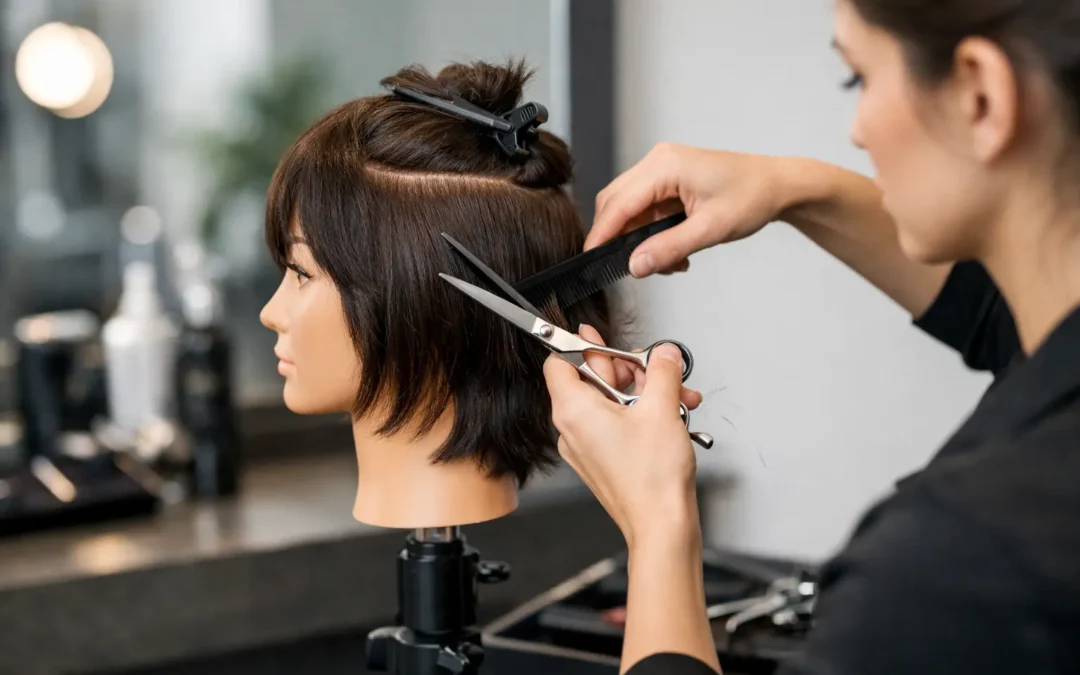
A haircut can look simple when an experienced stylist does it. Behind a clean bob, balanced fade, or soft layered shape are dozens of small decisions about sectioning, elevation, tension, body position, and finish. Learning how to practice haircutting skills is about repeating those decisions with intention until your hands, eyes, and professional judgment work together.
For aspiring hairstylists and barbers, practice should do more than fill hours. It should build the confidence to consult with a client, create a shape that suits them, and make adjustments when real hair does not behave like a textbook diagram. The strongest training combines focused repetition with instructor feedback, current techniques, and opportunities to work toward real salon standards.
Start With the Fundamentals of Haircutting
Before attempting a dramatic transformation or a highly textured social-media style, make the foundational techniques dependable. Haircutting is built on principles that apply across almost every service: clean partings, consistent tension, controlled elevation, accurate finger angles, and clear guide placement.
Practice creating sections that are neat and equal. This may feel basic, but rushed sectioning creates uneven weight distribution and makes it difficult to see the shape you are building. Then work slowly through one-length cuts, graduation, layers, and basic men’s cuts. These forms teach you how the hair responds when you change elevation and overdirection.
Use a mannequin when you are developing the mechanics of a new technique. A mannequin gives you room to pause, re-section, and repeat without putting pressure on a live client experience. It is especially useful for practicing a precise perimeter, building a graduation, or learning clipper control.
Still, mannequins cannot teach you everything. They do not move, communicate preferences, or arrive with different growth patterns, densities, and hair textures. As your control improves, supervised work on live models helps you develop the adaptability that makes a stylist employable.
Practice One Skill at a Time
A common mistake is trying to perfect an entire haircut during every practice session. This can make progress hard to measure. Instead, choose a technical goal for the day and make it specific.
You might focus on holding consistent tension through every section, maintaining a square layer, creating a smooth fade transition, or using shear-over-comb without leaving visible lines. After several repetitions, assess the result closely. Is one side heavier? Does the shape collapse in the crown? Are the clipper lines visible when the hair moves?
This approach helps you understand cause and effect. If the result is uneven, you can identify whether the issue came from the sectioning, your body position, the guide, or the cutting angle. That level of self-assessment is what turns practice into professional growth.
Build a repeatable practice routine
Set aside regular practice time and treat it like a client appointment. Prepare your station, sanitize your tools, choose the technique you are training, and take before-and-after photos. A consistent routine makes improvement visible over time.
It also helps to keep a simple practice journal. Record the haircut, the tools used, what went well, and one area to improve next time. For example, you may notice that your layers are balanced but your face framing needs softer blending. That insight gives your next session a purpose.
Use the Right Tools and Learn Their Purpose
Great results do not come from buying every tool available. They come from understanding what each tool is designed to do and maintaining it properly. A sharp cutting shear supports clean lines. Thinning or texturizing shears can remove weight when used with control, but overuse can create frizz or holes in the shape. Clippers, guards, trimmers, combs, clips, and spray bottles each have a role in a professional service.
Practice your tool handling before you speed up. Learn how to hold shears comfortably, move around the head without twisting your body, and keep the comb and shear coordinated. For barbering, practice your lever positions and guard progression on the same fade pattern repeatedly. The goal is not simply to memorize steps. It is to understand why a particular tool and technique create a particular result.
Clean, organized tools are also part of the skill. Clients notice your professionalism before the haircut begins. Good sanitation habits, a prepared workstation, and safe tool handling are non-negotiable in a salon or barbershop environment.
Learn to See Shape, Balance, and Detail
Haircutting is visual. You need to train your eye as much as your hands. Step back often and view the haircut from the front, sides, back, and above. Look at the overall silhouette before focusing on individual pieces. A technically clean section does not guarantee a balanced final shape.
Use mirrors to check symmetry, especially around the fringe, temples, nape, and neckline. Comb the hair in different directions and allow it to fall naturally. A cut can appear even when hair is held under tension but reveal imbalance once it is released.
Pay attention to details that separate an acceptable haircut from a polished one. Check the outline, remove unwanted bulk, refine the blend, and make sure both sides suit the client’s head shape and natural movement. These finishing steps should not be rushed. They are where your technical work becomes a professional result.
Practice on Different Hair Types and Textures
Practicing only on one mannequin or one type of model can limit your development. Hair density, curl pattern, porosity, cowlicks, and growth direction all influence the cutting approach. A blunt cut on straight, fine hair requires different control than a layered shape on dense curls or a clipper cut with strong crown growth patterns.
When possible, work with a range of hair types under guidance. Start with a clear consultation. Ask how the client styles their hair, how much time they want to spend on maintenance, and what they like or dislike about past cuts. Then explain your plan in clear, professional language.
This is where technical skill meets client care. The best haircut is not always the trendiest one. It is the one that works with the client’s hair, lifestyle, and goals. Learning to make that judgment is an essential part of building a lasting career.
Ask for Feedback Before You Move On
Honest feedback accelerates progress. An experienced instructor can spot a problem in your sectioning, hand position, or body mechanics before it becomes a habit. They can also explain how to correct it, rather than simply telling you that the haircut is uneven.
Invite constructive feedback during the service, not only after it is finished. If you are uncertain about your guide or blending method, ask early. Making a correction mid-service is part of professional practice, and it helps protect the client experience.
Peer feedback can be valuable as well, especially when you practice describing what you see. Instead of saying a haircut looks “off,” learn to identify the issue: excess weight behind the ear, inconsistent graduation, an unbalanced fringe, or a fade that needs more refinement. Speaking the language of the craft strengthens your confidence and communication.
Build Speed Only After Control
Speed matters in a busy salon, but rushing before your technique is reliable often leads to mistakes. First, learn to complete a cut with clean sections, proper posture, and a clear plan. Once your results are consistent, begin timing selected steps and look for more efficient movements.
Efficient does not mean careless. It means setting up your station well, minimizing unnecessary repositioning, and knowing your next section before you finish the current one. With enough guided repetition, speed becomes a natural outcome of confidence.
Train in an Environment That Reflects the Industry
Independent practice can improve your coordination, but career-ready confidence grows faster in a structured learning environment. You need opportunities to practice current cuts, receive immediate coaching, work with modern equipment, and build experience with real clients. Small class settings can make a meaningful difference because students have more access to personalized feedback while developing their own style and professional presence.
At The Beauty Academy, hands-on hairstyling and barbering education is designed to help students move from foundational techniques to client-focused services with support from experienced industry professionals. Training alongside peers, instructors, and live models creates the kind of practical judgment that employers value.
Your next practice session does not need to be perfect. Choose one skill, slow down, ask for feedback, and repeat it with purpose. Each careful section and refined detail brings you closer to the confidence to create work you are proud to show clients.